
Large format printing produces any printed output wider than 60cm. Banners, building wraps, posters, retail displays, trade show backdrops, site hoardings, and vehicle graphics all fall into this category. If your brand needs to be seen from a distance and hold up in real conditions, this large format printing explained guide gives you everything you need to get it right.
This guide covers what large format printing is, how it works, what it’s used for, and how to get an order right the first time.
What is large format printing?
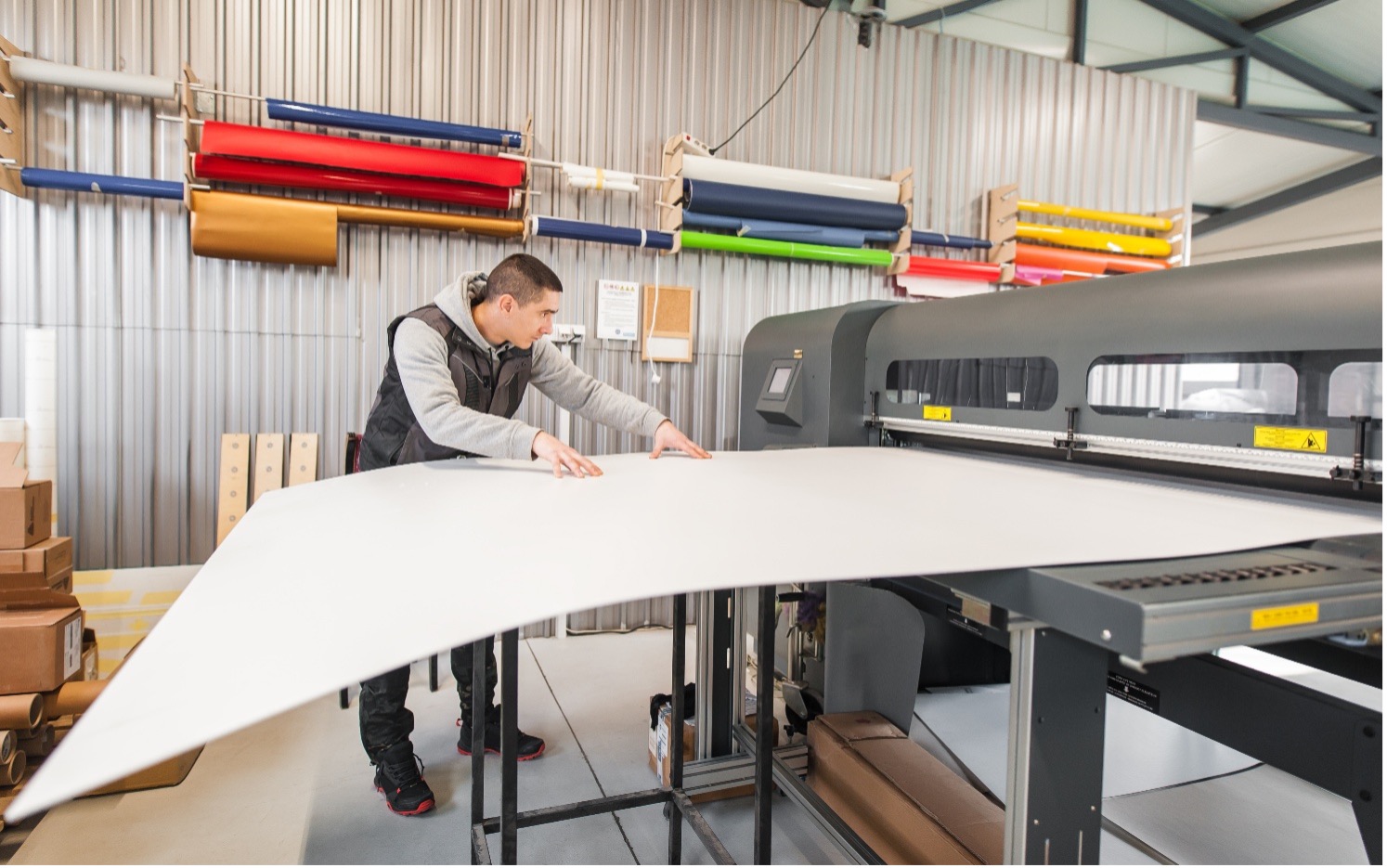
Large format printing, also called wide format printing, refers to any print produced on specialist printers handling substrates wider than standard commercial equipment, typically above 60cm wide.
The technology uses inkjet heads moving across wide rolls of substrate, depositing high-resolution large format prints across vinyl, fabric, canvas, paper, or rigid materials. Resolution is calibrated for viewing distance. A building hoarding at 75 DPI looks just as sharp as an A4 document at 300 DPI because nobody reads a hoarding from 20 centimetres away.
How is large format printing different from standard printing?
Standard commercial printing has a fixed maximum sheet size, typically A3. Large format printing removes that size constraint entirely.
The other difference is substrate range. Professional wide format printing solutions cover vinyl, canvas, mesh, fabric, foamcore, corflute, acrylic, and aluminium composite. That material range is what makes commercial large format printing suited to outdoor environments, event displays, interior branding, and vehicle graphics where paper simply won’t do.
When should you choose large format printing?
Large format printing is the right choice when visibility, durability, or scale requirements go beyond what standard print can deliver. Choose it when:
- Your brand needs to be seen from a distance at a shopfront, construction site, or event space
- You need custom signage solutions for a trade show, conference, or product launch
- You’re running a seasonal campaign requiring banners and poster printing services across one or more locations
- A standard printer can’t produce the size or substrate your job requires
- Your installation environment is outdoors, high-traffic, or requires weather-resistant materials
What materials are used in large format printing?
- Vinyl: The most common substrate for outdoor large format signage printing. UV-stable, weather-resistant, and available in self-adhesive, banner, and mesh formats.
- Fabric: Lightweight and packable. Used for trade show displays, media walls, and event backdrops. Backlit options available for illuminated displays.
- Canvas: Textured and gallery-quality. Common for canvas prints in offices, hospitality venues, and retail interiors.
- Corflute: Corrugated plastic suited to temporary signage, A-frame inserts, and construction site notices.
- Foamcore: Lightweight foam board for indoor presentation displays and point-of-sale graphics.
- Acrylic and aluminium composite: Rigid, premium substrates for permanent outdoor signs and corporate reception installations.
Finishing options include lamination (gloss, matte, or satin), rigid mounting, and UV-resistant overlaminates for prints in direct sunlight.
What is large format printing used for?
Retail and shopfronts: Window decals, floor decals, pull-up banners, and outdoor banners for seasonal promotions and permanent shopfront branding.
Events and trade shows: Pop-up displays, media walls, feather banners, and exhibition stand packages. Event signage and conference signage are among the most time-sensitive large format jobs.
Construction: Site hoardings, safety signage, and project branding. A well-produced hoarding turns a building site into a billboard.
Corporate offices: Wall graphics, canvas prints, mounted posters, and lightboxes for branded interior environments.
Vehicle graphics: Full wraps and vehicle decals turn a company fleet into moving outdoor large format printing.
What are the benefits of large format printing for businesses?
- Visibility at scale: High resolution large format prints hold quality whether viewed up close or from across a car park
- Outdoor durability: Outdoor large format printing materials handle Australian sun, wind, and rain without fading or deteriorating prematurely
- Custom sizing: No constraints on creative or installation requirements, from a small A-frame insert to a multi-metre building hoarding
- Fast turnaround: Many standard large format jobs are ready next business day at local Kwik Kopy centres
- End-to-end service: Design, print, finishing, and delivery all handled by a single print partner reduces supplier management time significantly
- Multi-location consistency: Large scale printing services through a national network ensure the same quality across every site
What are the latest trends in large format printing?
Large format graphics printing is moving in a few clear directions worth knowing about before you plan your next job.
- Fabric displays: Fabric is replacing rigid PVC at trade shows. Lighter to transport, easier to store, and better-looking in a well-lit exhibition environment.
- Sustainable materials: Eco-solvent inks and recyclable substrates are becoming standard requests from corporate and retail clients with sustainability commitments.
- Retail experiential graphics: Full-wall retail installations using large format wall graphics are replacing painted feature walls in fit-outs. Faster and cheaper to update.
- QR-integrated signage: Static large format displays now often incorporate QR codes linking to digital content, combining physical print with digital engagement in one placement.
- Large-scale window graphics: Whole-shopfront window wraps are growing in retail as a cost-effective alternative to structural signage changes.
What industries use large format printing most?
- Retail: Seasonal campaigns, shopfront branding, and point-of-sale displays
- Hospitality: Venue signage, event backdrops, and menu displays
- Construction: Site hoardings, safety signage, and project branding
- Healthcare: Directional signage, wayfinding, and patient environment graphics
- Education: Campus wayfinding, event signage, and wall graphics
- Real estate: Property listing signage and development hoardings
- Events and exhibitions: Trade show displays and conference signage
- Corporate: Office interior branding and multi-location campaign rollouts
How do you order large format printing?
- Define your requirements: Confirm what the sign is for, where it will be displayed, how long it needs to last, and what size you need. These four questions determine everything downstream.
- Choose your material and finish: Vinyl, fabric, corflute, acrylic, or foamcore depending on the environment and display life. Finishing options include lamination, mounting, and UV overlaminate.
- Prepare your artwork file: PDF (PDF/X-1a preferred), CMYK colour mode, 100 to 150 DPI at final print size, 5mm bleed on all sides. Don’t have artwork? Kwik Kopy’s graphic design team builds print-ready files from scratch.
- Request a quote: Submit online or contact your nearest centre with your size, quantity, material, and deadline. Pricing factors include size, material, quantity, complexity, and turnaround time.
- Approve your proof: A proof is sent before production begins. Check spelling, dimensions, colour, and bleed before approving.
- Production and delivery: Many standard jobs are ready the next business day. Multi-site custom large format printing orders are coordinated centrally and delivered locally through Kwik Kopy’s national network.
How do you choose the right large format printing solution?
- Display environment: Confirm indoor or outdoor before choosing a substrate. Outdoor materials must be UV-stable and weather-resistant.
- Display life: Temporary event signage needs different materials than permanent building signage.
- Size: Always confirm final print dimensions before building your file.
- Artwork: If print-ready artwork isn’t available, factor in design time or use a centre with in-house support.
- Deadline: Communicate your deadline at the time of enquiry.
Frequently asked questions
1: What is considered large format printing?
Large format printing refers to any print wider than approximately 60cm, including banners, posters, wall graphics, vehicle wraps, site hoardings, and trade show displays.
2: What materials are used in large format printing?
Vinyl, fabric, canvas, corflute, foamcore, acrylic, and aluminium composite are the most common. Material choice depended on the display environment and required display life.
3: What is large format printing used for?
Retail displays, event signage, conference signage, construction hoardings, vehicle graphics, office interior branding, and outdoor advertising signage.
4: Is large format printing suitable for outdoor use?
Yes. Vinyl, mesh, and corflute substrates handle outdoor conditions with UV-stable inks and weather-resistant coatings. Lamination extends outdoor display life further.
5: What is the difference between wide format and large format printing?
The terms are interchangeable in the industry. Both refer to printing on equipment handling substrates wider than standard commercial printers, typically above 60cm.
Get your brand seen. Talk to Kwik Kopy today.
90+ centres across Australia. End-to-end service from design through to delivery. Fast turnaround on standard jobs. Expert local advice on every job, every time.
Whether you need a single pull-up banner, a full suite of poster printing services, or a coordinated signage and display solutions rollout across multiple locations, Kwik Kopy handles it from concept to completion. Your print partner. We invite you to bring us your impossibles.